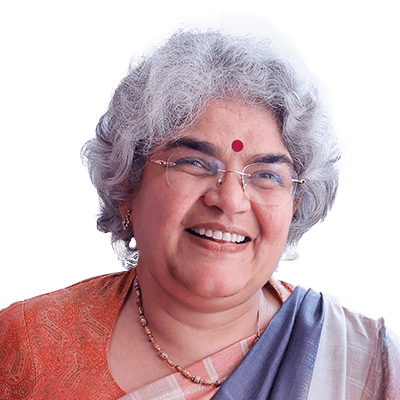
Gayathri Vasudevan
Chief Impact Officer
Sambhav Foundation
Dr. Gayathri built Sambhav Foundation with a vision to enable livelihoods and to enhance quality of life of vulnerable communities through Education, Employability and Entrepreneurship. Her mission was to touch millions of lives, empower youth, men and women to earn a decent living and become micro entrepreneurs.
She has been extensively involved in policy issues and community mobilizations relating to labour and livelihoods, leading to recognition and accolades across the globe. Gayathri was cited as one of the top 50 women in business by Business Today, a leading magazine in India in the year 2017 and “Entrepreneur of the Year in Social Business Category” by Forbes India in 2018. She is also a recipient of NITI Aayog’s Women Transforming India Award for 2021. She has been a TED speaker several times. Between 1999 and 2007, Gayathri worked for the International Labour Organization (ILO), a United Nations agency.
She has a Doctorate in Development Studies, with 30 publications in the areas of labour, employment and gender issues to her credit.
Julian Matthews is a British conservationist, eco-entrepreneur, and rewilding pioneer, widely recognised for his work in positioning sustainable tourism as a critical tool for wildlife conservation, particularly for the protection of the Bengal tiger. He is the Founder and Ambassador of TOFTigers (Travel Operators For Tigers), a global initiative he established in 2004 to align the tourism industry with conservation outcomes across the Indian subcontinent.
Through TOFTigers, Matthews has helped transform wildlife tourism from a passive economic activity into an active conservation instrument. As of 2026, the initiative works with over 220 travel and hospitality businesses worldwide, promoting responsible tourism standards that support habitat protection, anti-poaching efforts, and community livelihoods in and around tiger landscapes.
Matthews is the pioneer of the concept of “Tigernomics,” which reframes tiger conservation in economic terms, demonstrating that live tigers generate significantly greater long-term value for local communities and protected areas through regulated tourism than through extractive or illegal activities. The framework has been widely referenced in discussions on conservation finance and sustainable development.
Beyond India, Matthews leads Real Wild Estates, where he is actively involved in rewilding projects in the United Kingdom and internationally, focused on restoring degraded landscapes, enhancing biodiversity, and re-establishing ecological balance. His work emphasises the importance of ecological carrying capacity and long-term land stewardship over short-term commercial exploitation.
A strong advocate for community-based conservation, Matthews frequently writes and speaks on sustainable tourism models that link rural livelihoods with wildlife protection. In recent years, he has underscored the need for mindful tourism practices that prioritise animal welfare, habitat integrity, and local ownership, particularly as wildlife destinations face increasing pressure from mass tourism.
In 2025, Matthews served as Founder and Ambassador of the TOFT Wildlife & Nature Tourism Awards, recognising excellence and leadership in responsible tourism across India. His recent work also continues to honour and build upon conservation legacies, including that of the late Valmik Thapar, by advocating for specialised nature tourism such as birding, research-led travel, and conservation volunteering.
Through his long-standing engagement with conservation science, tourism economics, and rewilding practice, Julian Matthews remains a respected global voice on how tourism, when properly governed, can strengthen conservation rather than undermine it.